


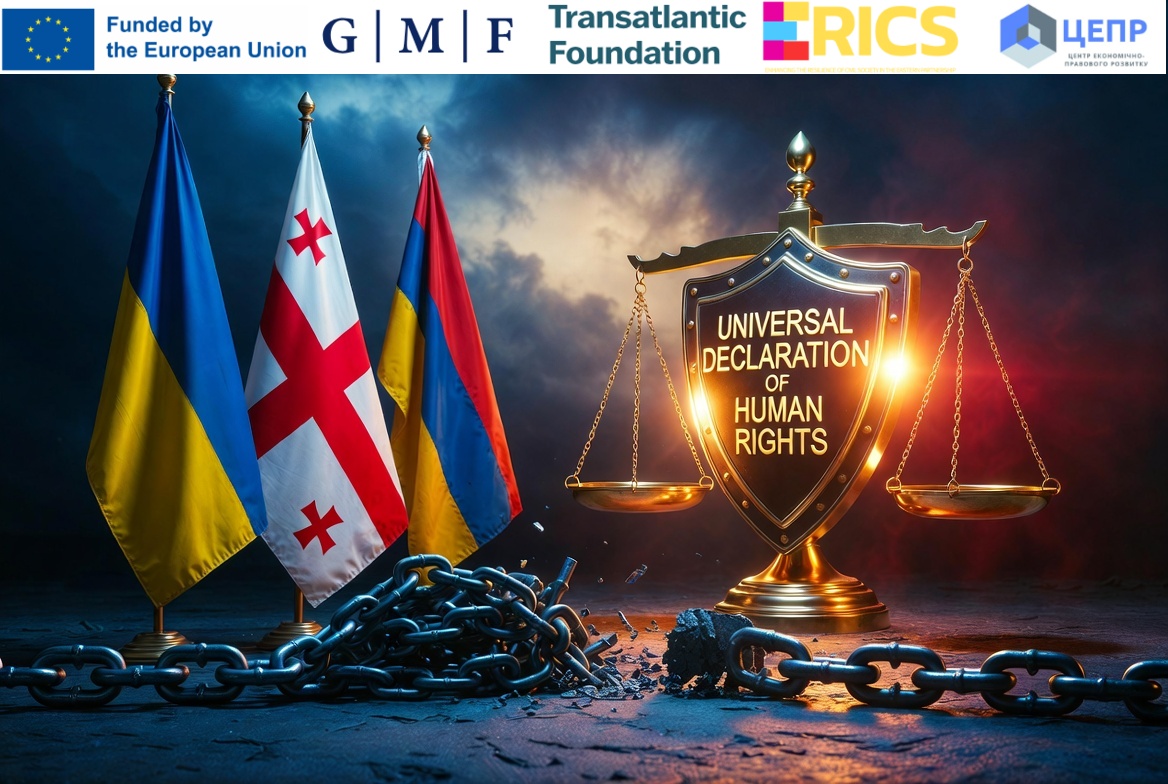
Introduction
Human rights remain a critical issue across Eastern Europe and the Caucasus. Despite differing political and social contexts, Ukraine, Georgia, and Armenia face similar challenges in protecting fundamental freedoms. This article examines key cases of violations in these countries and analyzes effective response mechanisms.
1. Major Types of Human Rights Violations
1.1. Political Persecution & Repression
Ukraine:
Persecution of Crimean Tatars in occupied Crimea
Illegal imprisonment of Ukrainian citizens in Russia (e.g., Oleg Sentsov case)
Georgia:
Violent crackdown on protests against the “foreign agents” law (2023)
Politically motivated prosecutions (e.g., case of ex-President Saakashvili)
Armenia:
Post-war political instability following the Nagorno-Karabakh conflict
Intimidation of opposition journalists
1.2. 1.2. Discrimination & Minority Rights Violations
Ukraine:
Challenges in reintegrating IDPs from occupied territories
Discrimination against the Roma community
Georgia:
Systemic discrimination against the LGBTQ+ community
Rights violations of ethnic minorities in Samtskhe-Javakheti
Armenia:
Lack of protections for the Yazidi minority
Issues facing Nagorno-Karabakh refugees
1.3. 1.3. Violations in Conflict Zones
Ukraine:
Russian war crimes (Bucha, Mariupol massacres)
Deportation of Ukrainian children (recognized as genocide)
Armenia:
Ethnic cleansing in Nagorno-Karabakh (2023)
Mistreatment of Armenian prisoners of war
2. Effective Protection Mechanisms
2.1. International Tools
All three countries rely on:
UN Human Rights Council mechanisms
European Court of Human Rights (ECHR)
OSCE monitoring missions
Ukraine-specific:
International Criminal Court (arrest warrants for Russian officials)
Georgia-specific:
EU-UN joint reform programs
Armenia-specific:
EU monitoring mission (since 2023)
2.2. 2.2. National Mechanisms
Ukraine:
Office of the Prosecutor General (war crimes investigations)
Parliament Commissioner for Human Rights
Georgia:
Special Prosecutor’s Office against organized crime
Parliamentary Human Rights Committee
Armenia:
Human Rights Defender (Ombudsman)
Special Investigative Service
2.3. 2.3. Civil Society & Media
Common strengths:
Social media as a tool for documenting abuses
Independent investigative journalism
Ukraine:
Center for Civil Liberties (Nobel Peace Prize 2022)
Investigative outlets like “Schemes” and “Slidstvo.Info”
Georgia:
Transparency International Georgia
Independent TV station “Mtavari Arkhi”
Armenia:
Anti-corruption movement
Investigative outlet “Hetq”
Key Takeaways & Recommendations
Shared Challenges:
Russian aggression (direct or indirect impact)
Need for judicial reforms
Corruption as a systemic issue
Best Practices:
Ukraine’s war crime documentation model
Georgia’s anti-corruption reforms
Armenia’s refugee protection mechanisms
Recommendations:
Strengthen international cooperation
Facilitate cross-country experience sharing
Support independent media and civil society
This publication was produced with the financial support of the European Union and the Black Sea Trust
for Regional Cooperation. Its contents are the sole responsibility of NGO CEPR and do not necessarily reflect the views of the European Union and the Black Sea Trust for Regional Cooperation






Discussion about this post