

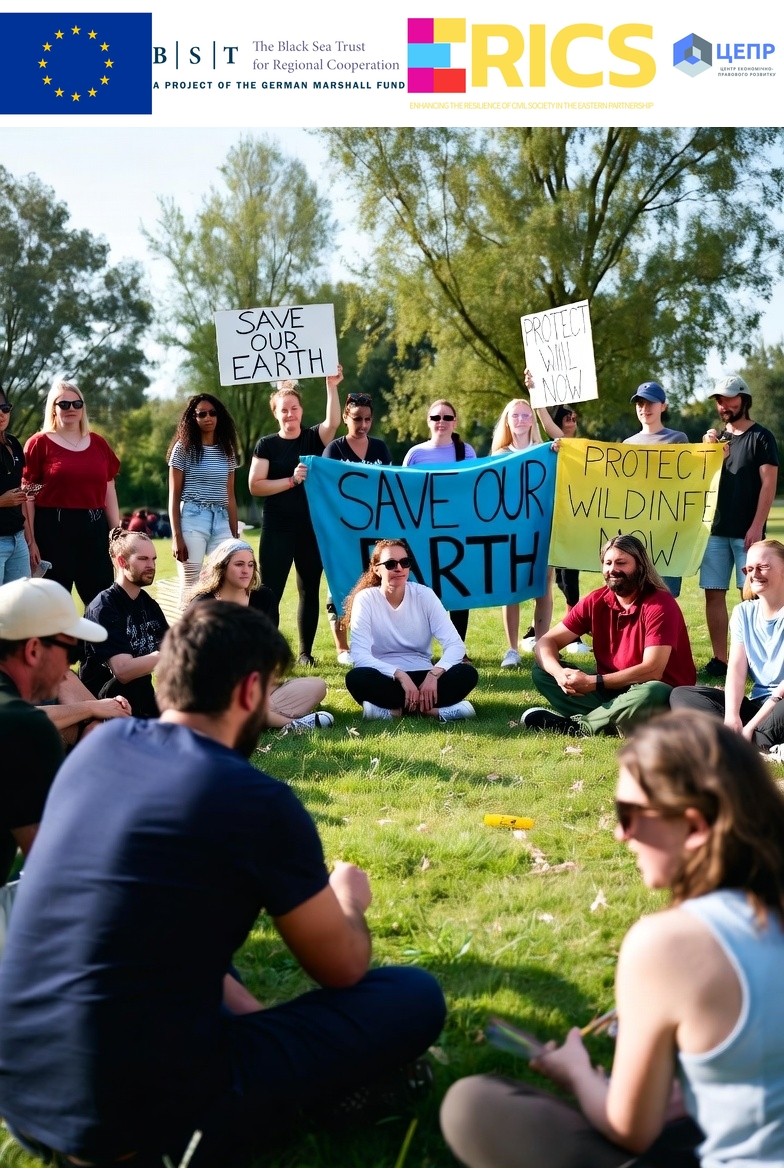
Environmental rights have long ceased to be an abstract concept. They are the right to breathe clean air, drink safe water, and live on uncontaminated land. When these rights are violated, the most effective mechanism for protection is often not individual actions, but the united efforts of entire communities. The experience of Eastern European countries, particularly Ukraine, Georgia, and Armenia, clearly demonstrates that an active civic position can stop even the most powerful corporations.
Why is this important? Ecology is a Human Right
Environmental protection is not just about caring for nature. It is a matter of health, economics, and quality of life. Air pollution causes respiratory diseases, poisoned water leads to cancer, and degraded land results in hunger and migration. Therefore, the fight for environmental rights is a fundamental struggle for the future.
How can communities act? Tools and approaches:
Legal Defense: Using laws on access to information, public participation in decision-making, and access to justice. Filing complaints with state authorities, administrative and court lawsuits.
Public Pressure and Protests: Rallies, pickets, petitions, public appeals to the government. This attracts media attention and shapes public opinion.
Environmental Education: Self-study of the problem, engaging independent experts to conduct research and monitoring.
Coalitions and Networks: Uniting with other communities, environmental organizations, and activists to increase influence.
Examples of Successful Activism
Ukraine: The Victory of Law and the Public over Waste Incineration
One of the most prominent victories of Ukrainian eco-activism was the story of the construction of a waste incineration plant near Kyiv, in the village of Kalynivka. The project was initiated by the Chinese company “China National Complete Plant Import and Export Corporation”.
The Problem: The project involved burning thousands of tons of trash daily from the capital, threatening emissions of dioxins, heavy metals, and other hazardous substances.
Community Actions: Residents of Kalynivka and activists united in a coalition. They organized numerous rallies, commissioned independent expert assessments which confirmed the project’s danger, and engaged journalists and lawyers. Activists used both mass protests and administrative complaints.
The Result: Under public pressure, the State Architectural and Construction Inspection of Ukraine revoked the construction permit for the plant. This was a convincing victory that showed that even without significant financial resources, but with good organization and legal tools, a community can win.
Georgia: Protecting a National Park from Hydroelectric Power Plants
In Georgia, where hydropower is actively developing, communities have risen to protect unique nature. A prime example is the fight to save the Mtirala National Park from the construction of a series of small HPPs.
The Problem: The construction of the HPPs would have destroyed pristine forests, disrupted river ecosystems and the unique landscape of the park, threatening the region’s tourist appeal.
Community Actions: Local residents, ecologists, and activists created the “Save Mtirala” movement. They set up protest camps directly at the construction site, blocking the road for machinery. The actions were accompanied by a social media campaign, petition drives, and constant public awareness efforts.
The Result: The protests lasted for months. Eventually, the Georgian government made concessions. The construction of one of the most controversial HPPs was stopped, and the park territory received additional protection guarantees. This victory proved the power of non-violent direct action and solidarity.
Armenia: The Fight for Clean Air in Yerevan
The capital of Armenia, Yerevan, suffered for years from severe air pollution due to outdated industrial production. One of the main sources of the problem was the Ararat Cement plant.
The Problem: The plant, located directly within the city limits, emitted huge amounts of dust and harmful substances into the atmosphere, leading to an increase in illnesses among residents.
Community Actions: Public activists and residents of adjacent districts launched the “For Clean Air in Yerevan” campaign. They conducted independent air quality measurements, the results of which were significantly worse than official data. Activists filed lawsuits, organized rallies, and demanded that the authorities implement strict environmental standards.
The Result: Public pressure forced the authorities to strengthen control over the plant’s emissions. The owners of the enterprise were forced to invest in modernizing equipment and installing purification systems. Although the problem is not completely solved, air quality has noticeably improved, demonstrating that systematic work and expert approaches yield results.
Conclusion: Solidarity, Information, and Perseverance
The experience of Ukraine, Georgia, and Armenia all point to one conclusion: success comes when a community acts together, uses all available tools—from rallies to courts—and does not give up. The key success factors are:
Access to Information: Knowing your rights and obtaining accurate data on pollution.
Expert Support: Engaging independent scientists and lawyers.
Publicity: Wide coverage in the media and social networks.
International Support: Appealing to international environmental organizations and institutions.
The fight for a clean environment is a marathon, not a sprint. But every victory, big or small, makes our lives safer and our environment healthier. The right to a clean environment is not given; it is won.

{{current_weather.dt | momentjs( atts.date )}}
{{current_weather.temp | temp}} °{{units}}
{{day.dt | momentjs(atts.date)}}
{{day.temp | temp}} °{{day.temp_min | temp}} °{{units}}
Environmental Rights: How Communities Can Fight for a Clean Environment? Lessons from Ukraine, Georgia, and Armenia






The website was created with the financial support of the European Union and the Black Sea Trust for Regional Cooperation.

Discussion about this post