


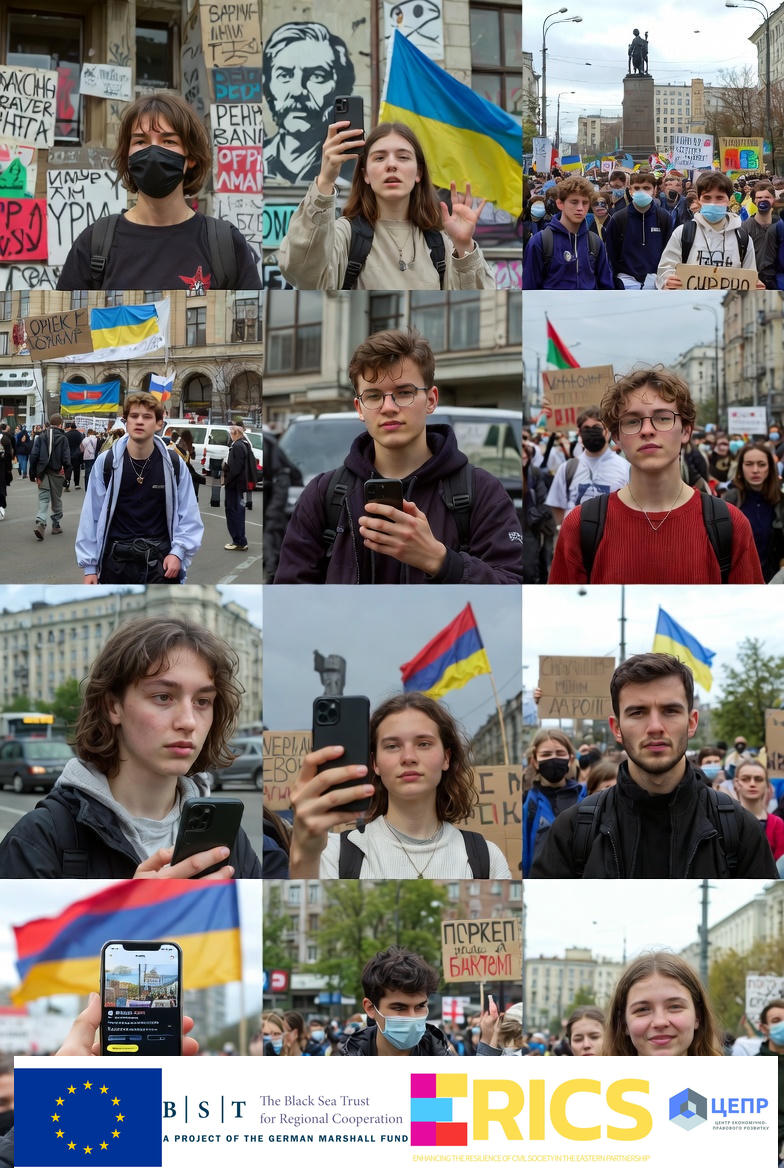
There are frequent complaints that today’s youth are indifferent, immersed in digital worlds, and detached from socio-political realities. But is this really the case? The history of the last two decades in the post-Soviet space is an epic saga about how precisely young people, with their ideals, smartphones, and unwavering belief in the future, became the main architects of political upheavals. Their participation long ago transcended mere formality—voting once every four years. It has become a living, sometimes relentless, movement that intertwines online activism with offline action, culture with politics, street protest with systemic work.
Recall Ukraine. The Orange Revolution in 2004 first engaged youth as an active force on a massive scale. But the true lesson came from the events of the Revolution of Dignity in 2013-2014. Back then, students didn’t just take to the Maidan. They organized a network of volunteer centers: preparing food, sewing balaclavas, building barricades, setting up medical aid stations, coordinating help through social networks. This was politics as an act of direct self-activity and self-governance. After the Revolution’s victory, many of them did not go home. They went to the front as volunteers, created volunteer battalions, and developed a powerful crowdfunding and volunteer infrastructure that saved the state in its most difficult times. Today, these people are in the Verkhovna Rada, local councils, and are successful civic activists. Their path: from protest to responsibility, from social networks to institutions. And with the start of the full-scale war, youth are again on the front lines: these are IT specialists developing digital products for the army, media professionals waging the information front, thousands of volunteers building logistics for rescue operations.
Georgia is a vivid example of how youth culture becomes a political force. 2018-2019. The government’s reluctance to fulfill its promise to transition to a proportional electoral system sparked a wave of protests, led precisely by young people, often from creative circles. But a year earlier, youth played a key role in the clash with Russian MP Gavrilov in the Georgian parliament. A spontaneous, deeply emotional protest grew into large-scale rallies under the slogan “Dignity!” Young Georgians, who speak English fluently and are oriented toward Europe, used social networks to mobilize and broadcast their struggle to the whole world. They showed that for them, politics is a matter of civilizational choice and national identity. Their activism continues today, manifesting in rallies supporting Ukraine or defending Euro-integration courses.
Armenia in 2018 is perhaps the most impressive case of a peaceful transfer of power through youth mobilization. The “Velvet Revolution,” led by Nikol Pashinyan, began with a march on foot by young activists across the entire country. This was not a classic rally in the capital. It was a slow, deliberate movement that gained strength and supporters in every village and town. Young people, tired of corruption and the same ruling power for decades, became the driving force. They used social networks for coordination, but their main weapon was peaceful, yet unwavering, civil disobedience. Schoolchildren, students, and young professionals blocked government buildings, occupied public spaces, demonstrating an entirely new format of political participation—horizontal, networked, creative. They proved that even within an authoritarian system, change can be achieved without violence, solely through the power of mass solidarity.
Even in the extremely harsh conditions of Belarus in 2020, youth demonstrated incredible courage and innovation. When traditional media were blocked and opposition politicians arrested, it was young people who organized mass actions, disseminated information, and coordinated activities through Telegram channels (e.g., NEXTA). They turned symbolism into a political tool: the white-red-white flags, traditional embroidered shirts (vyshyvankas), portraits of the arrested became symbols of resistance. Large-scale youth flash mobs—bike rides, neighborhood gatherings, spontaneous applause in courtyards—this was a new language of protest, understandable to their generation. Despite harsh repression, students organized strikes and petitions. Young Belarusians demonstrated that political participation can take the form of quiet but massive civil disobedience and alternative self-organization in conditions where all traditional channels are closed.
So, how can youth participate? The answers lie in these stories. First, through digital activism: creating content, fact-checking, organizing in messengers, applying pressure through online petitions. Second, through volunteering and civic initiatives: assisting the Armed Forces, environmental projects, helping internally displaced persons—this is also politics, as it shapes social bonds and solves problems that authorities are often powerless to address. Third, through culture and art: street performances, graffiti, songs, documentary films can be more powerful than political speeches. Fourth, through local self-governance: joining youth councils, participating in participatory budgeting, initiating changes in one’s own courtyard, university, district. And finally, through entering politics professionally: creating youth wings of parties, participating in elections, lobbying youth-related draft laws.
The success stories from Ukraine, Georgia, Armenia, and Belarus convey one thing: youth are not the future; youth are the present. They do not wait to be invited into political processes. They enter them on their own, sometimes through the door, sometimes through broken windows, creating new rules of the game. Their strength lies in their faith, tech-savviness, connectedness, and radical honesty. Their participation is not a ritual but a vital necessity. Because politics is not only what happens in parliament. It is what happens on the street, on your phone, in your village, in your mind. And today, it is the youth who understand this best.






Discussion about this post